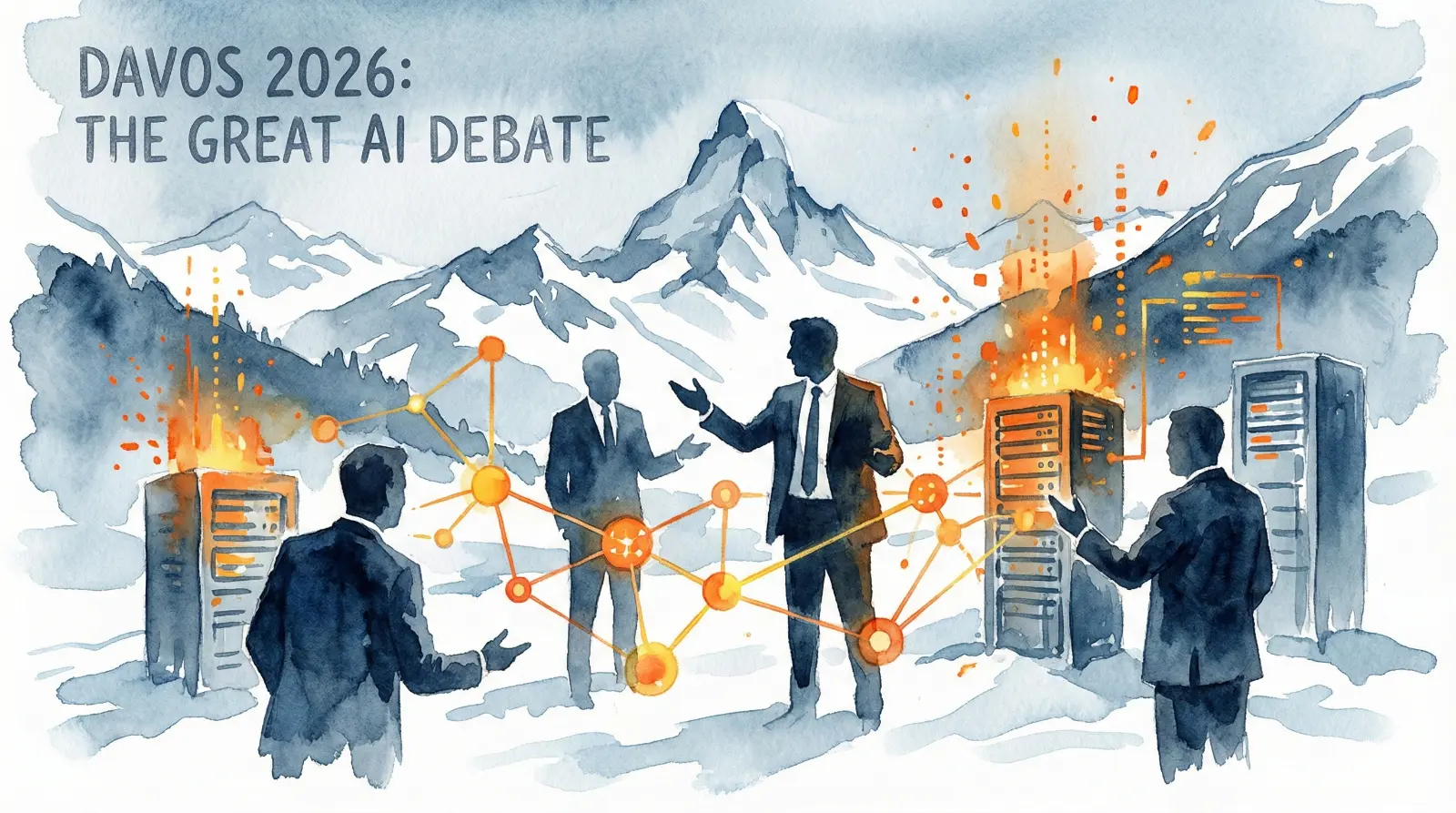
Davos 2026 exposed deep fractures among tech CEOs regarding the future of Artificial Intelligence. Microsoft's Satya Nadella warned of an AI bubble if the technology fails to deliver real economic returns, while Nvidia's Jensen Huang championed continued massive infrastructure spending, framing it as a new industrial revolution. The summit also saw intense geopolitical friction, with Anthropic's Dario Amodei criticizing US chip sales to China as a security threat comparable to selling nuclear arms. With additional concerns over energy shortages and workforce displacement, the event signaled that AI has transitioned from a purely technological marvel to a central driver of global economic and political conflict.
The World Economic Forum in Davos, Switzerland, is typically the stage for high-level discussions on global poverty, climate change, and macroeconomic stability. However, the 2026 summit presented a starkly different picture. Amidst the snowy peaks, the primary heat source was the intense friction surrounding Artificial Intelligence. Leaders of the world's most dominant technology companies gathered not just to laud the potential of AI, but to engage in sharp, often contradictory debates regarding its future. The consensus that once unified the tech industry has fractured, revealing deep philosophical and strategic rifts between the builders of AI infrastructure and the creators of AI applications.
The most significant highlight of this year's forum was the ideological clash between Microsoft CEO Satya Nadella and Nvidia CEO Jensen Huang. Nadella, whose company has bet its future on integrating AI into software, sounded a note of caution that resonated through the Alpine halls. He argued that the industry must move beyond the "hype cycle" and demonstrate tangible economic value. Nadella’s warning was clear: if the billions of dollars poured into AI do not translate into real-world profits and productivity gains soon, the industry risks facing a burst bubble. His stance reflects the growing anxiety among investors who are seeing massive capital expenditure without the immediate returns they were promised.
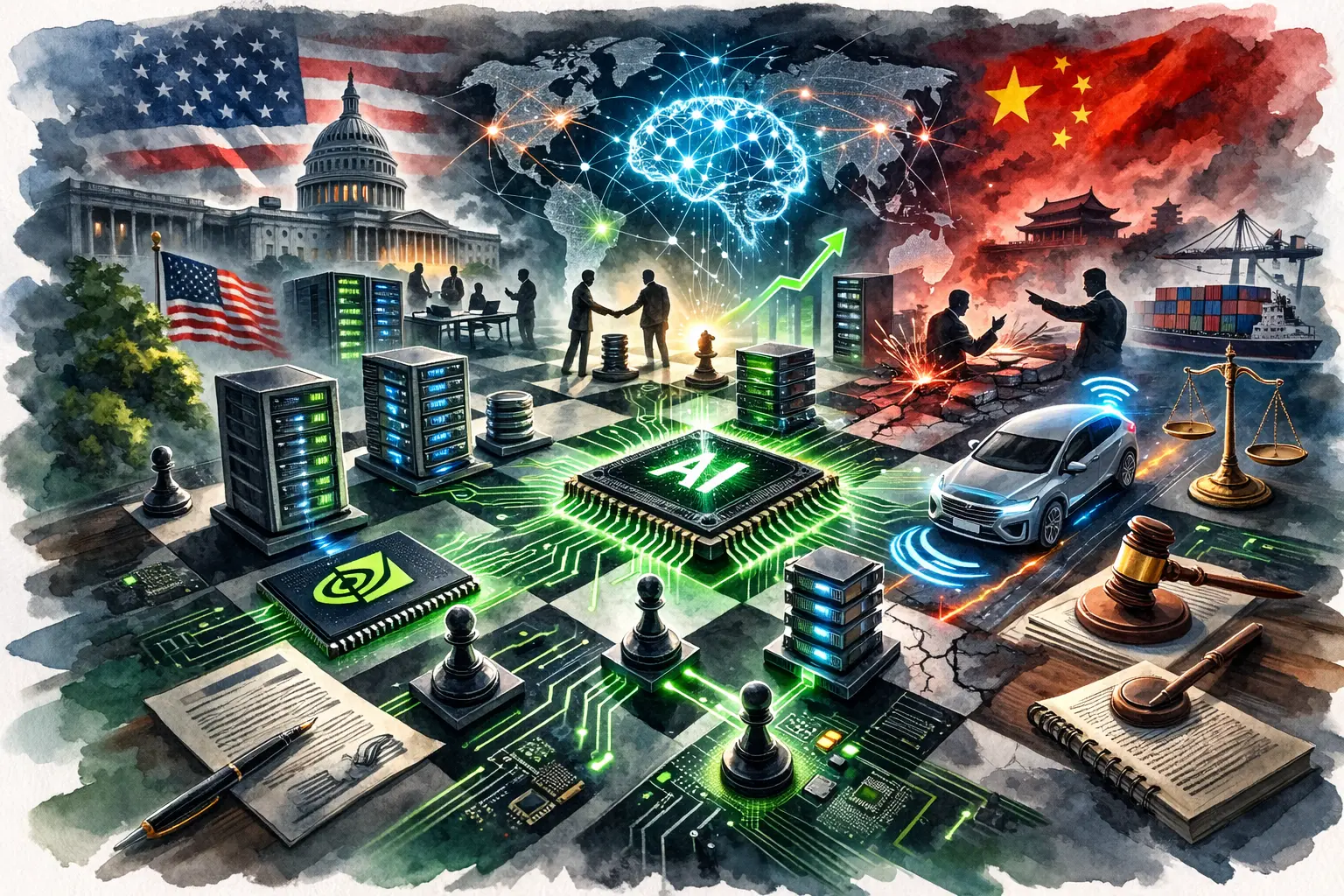
In stark contrast, Jensen Huang, the man whose chips power the AI revolution, dismissed the idea of a slowdown. For Huang, this is not merely a software update cycle but a fundamental industrial revolution comparable to the invention of the steam engine or electricity. He argued passionately for continued, aggressive investment in infrastructure, stating that the construction of "AI factories" is just beginning. According to Huang, pausing or moderating investment now would be a strategic error, as the demand for computing power is only going to scale exponentially. While Nadella preaches fiscal discipline and ROI, Huang preaches the gospel of infinite scalability.
This divergence highlights the current structural tension in the tech world. Software giants like Microsoft and Google are under immense pressure to monetize AI tools to justify their spending, while hardware providers like Nvidia are enjoying historic profits from selling the very infrastructure causing that expense. It is the classic tale of the gold rush: the one selling the pickaxes and shovels is making a fortune, while the prospectors are still digging, hoping the gold they find is worth the cost of the tools. This dynamic created an undercurrent of friction at Davos, as software CEOs hinted at the need for cheaper compute, while hardware CEOs pushed for larger clusters.
The skepticism was not limited to financials; it extended to the utility of the technology itself. Cloudflare CEO Matthew Prince did not mince words, describing many current AI pilot projects as "science fair projects." His critique strikes at a core fear in the industry: that despite the dazzling demos, many AI applications have yet to graduate from cool experiments to mission-critical business tools. Palantir CEO Alex Karp echoed this sentiment, suggesting that while chatbots are impressive, the real value lies in AI's ability to navigate complex, high-stakes environments like battlefields or industrial supply chains, an area where generic Large Language Models often stumble.
Beyond the boardroom economics, Davos 2026 also became a battleground for AI geopolitics. Anthropic CEO Dario Amodei delivered a scathing critique of the US trade policies under the Trump administration, specifically regarding the sale of advanced chips to China. Amodei drew a chilling parallel, comparing the sale of high-end AI processors to China as equivalent to selling nuclear weapons to North Korea. His argument posits that AI is not just a commercial commodity but a national security asset. This perspective clashes directly with the interests of chipmakers who view China as an indispensable market.
This geopolitical tug-of-war places Silicon Valley in a precarious position. On one side, there is the drive for maximum revenue and market expansion; on the other, the growing demand for national security and containment. The debate at Davos suggests that the era of borderless technology is ending. Companies are now being forced to choose sides, and the free flow of high-tech silicon is becoming a casualty of a new technological Cold War. The friction between safety-focused leaders like Amodei and market-focused executives creates a complex web of alliances and rivalries that will define the next decade of tech policy.
Another looming crisis discussed with refreshing honesty was the energy constraint. The AI industry is colliding with physics. The sheer amount of electricity required to power the next generation of data centers is staggering, and global power grids are ill-equipped to handle the load. Tech leaders are realizing that they can write code infinitely, but they cannot generate power infinitely. This has moved the conversation from "how many parameters does the model have?" to "do we have enough megawatts to turn it on?" The energy barrier is proving to be the hardest reality check for the industry's exponential growth plans.
The impact on the workforce remained a contentious topic, with a shift in narrative toward "Agentic AI." Salesforce CEO Marc Benioff championed the arrival of autonomous AI agents that can perform tasks without human intervention, claiming they will revolutionize productivity. While executives like Workday’s Carl Eschenbach tried to soothe fears by framing it as a transformation of roles rather than elimination, the anxiety was palpable. The discussion has moved beyond AI helping humans to write emails, to AI agents actively negotiating contracts and managing workflows, raising uncomfortable questions about the future of white-collar employment.
Perhaps the most controversial leadership advice came from Siemens Energy Chairman Jim Hagemann Snabe, who suggested that CEOs might need to act like "dictators" to force AI adoption within their organizations. His rationale is that bottom-up consensus is too slow for the pace of this technological shift. This statement encapsulates the desperation and urgency felt by legacy companies. They fear that if they do not ruthlessly integrate AI now, regardless of internal resistance, they will be obsolete within years.
Ultimately, Davos 2026 marked the end of the AI honeymoon. The blind optimism of the past two years has been replaced by hard-nosed pragmatism and defensive posturing. The questions are no longer about what AI can do, but about what it costs, who controls it, and whether it is safe. The clash between Nadella’s caution and Huang’s accelerationism is symbolic of an industry at a crossroads, trying to balance the fear of missing out with the fear of blowing up.

No Comment Yet.
Stay informed with breaking news, trending stories, and in-depth analysis.