
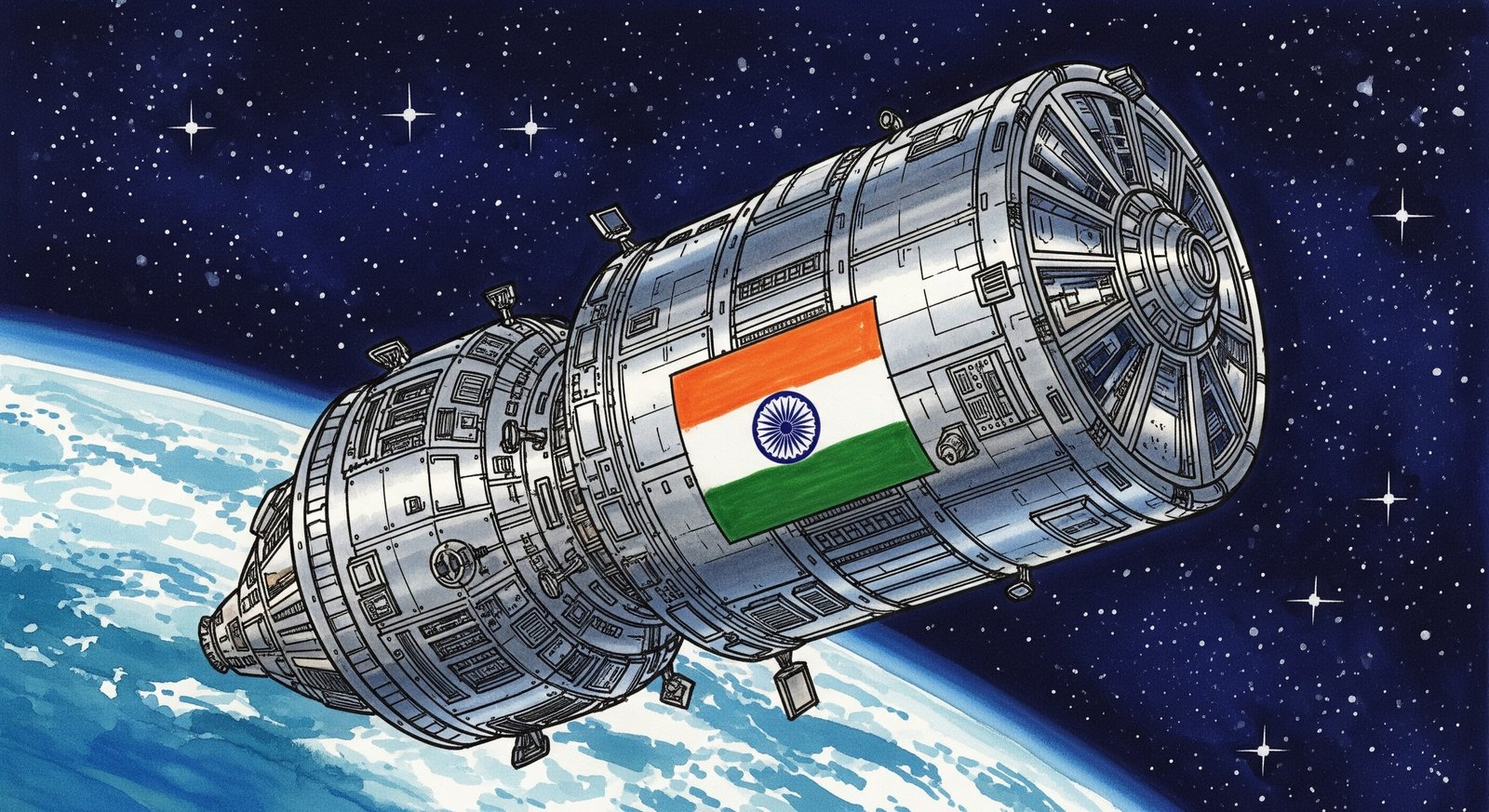
For decades, humanity’s relationship with space has been that of a visitor—a brief excursion into the unknown before returning to the safety of Earth. But that narrative is changing fast. After planting its flag on the Moon’s south pole and studying the Sun, India is now preparing to build a permanent residence among the stars. The Indian Space Research Organisation (ISRO) has made a defining announcement today, Monday, January 12, 2026. The definitive design for the first module of the Bharatiya Antariksha Station (BAS) has been officially finalized. This isn't just a technical update; it is a declaration that India is ready to join the exclusive club of nations—alongside the US, Russia, and China—that operate their own sovereign outposts in orbit.
The green signal was given following a high-level strategic meeting at the UR Rao Satellite Centre in Bengaluru earlier today. Top scientists and engineers, who have been working tirelessly on the blueprints for over two years, presented the final design which has successfully passed all preliminary simulations. This project is being viewed as the crown jewel of India’s Amrit Kaal vision. At a time when the International Space Station (ISS) is nearing its retirement, India’s decision to construct an independent station demonstrates a forward-thinking roadmap that prioritizes strategic autonomy in aerospace technology.
According to the specifications released today, the first segment of the station, technically called the Base Module, will weigh approximately 8 tons. In simple terms, this will serve as the primary living quarters and laboratory for Indian astronauts. It is designed to be deployed into a Low Earth Orbit (LEO) at an altitude of 400 kilometers. This specific orbit is crucial as it offers the perfect environment for Earth observation and microgravity experiments. The module will be equipped with state-of-the-art shielding to protect the crew from space debris and radiation, ensuring a safe habitat in the harsh vacuum of space.
Perhaps the most critical component of this ambitious project is the Environmental Control and Life Support System (ECLSS). This complex web of technology is responsible for generating oxygen, recycling water, and managing waste—essentially keeping the astronauts alive. What makes this a moment of pride for Karnataka is the heavy involvement of the Defence Food Research Laboratory (DFRL) in Mysuru. They are developing the specialized food menus and waste management protocols. So, when Indian astronauts eventually float in zero gravity, their survival and nutrition will be powered by homegrown technology from Mysuru.
The operational plan reveals that the station will initially be able to accomodate a crew of two astronauts. These missions are expected to last between seven to ten days, allowing the crew to conduct vital research in physics, biology, and material sciences under microgravity conditions. ISRO has adopted a modular approach, much like assembling Lego blocks in the sky. After the Base Module is established, additional units will be launched and docked using robotic arms. ISRO has already made significant strides in developing these robotic interfaces which will be essential for in-orbit assembly.
The ISRO Chairman has designated 2026 as the Year of Readiness. This implies that the current year will be packed with rigorous testing and validation missions. The Gaganyaan program will see multiple unmanned flight tests this year to certify the human-rating of the launch vehicles and crew modules. Kicking off this busy calendar is the launch of the SSLV D4 rocket scheduled for later this month. While this mission will deploy three small satellites, its success is vital for demonstrating ISRO’s launch frequency capabilities and commercial viability.
Beyond the government sector, India’s private space industry is experiencing its own golden age. Startups like Skyroot Aerospace from Hyderabad and Agnikul Cosmos from Chennai are prepping for major commercial launches in the first quarter of 2026. The long-term vision suggests a symbiotic relationship similar to the NASA-SpaceX model, where private Indian players could eventually run supply missions to the Bharatiya Antariksha Station, carrying cargo, fuel, and scientific equipment. This would free up ISRO to focus on deep space exploration and human safety.
Another exciting dimension to this announcement is the prospect of space tourism. ISRO is currently finalizing a feasibilty report on opening space travel to regular citizens by 2030. Today's design freeze on the space station is a critical step towards making that sci-fi dream a reality. The safety standards and life support systems being built for the BAS will form the foundation for future commercial tourist flights. It envisions a future where space isn't just for scientists, but accessible to the adventurous public.
In conclusion, the foundation for a developed India by 2047 is being laid in 2026. Self-reliance in space technology is no longer just about national prestige; it is a strategic necessity for communication, defense, and resource management. If Chandrayaan gave India confidence, the Bharatiya Antariksha Station challenges its competence to sustain human life beyond Earth. With today’s announcement, India has accepted that challenge, signaling to the world that its flag will not just wave on celestial bodies, but will have a permanent address among them.

No Comment Yet.
Stay informed with breaking news, trending stories, and in-depth analysis.