Future world wars will not be fought on national borders; they will take place on the invisible web of the internet. The space once occupied by human hackers is now being taken over by Agentic AI. This is a complete picture of the thrilling battle between robotic hackers that can think, attack, and defend independently without any command.
The nature of warfare in human history has been constantly changing. Fighting that started with just stones and sticks in the time of primitive humans later shifted to swords and shields. Eventually, guns, cannons, and fighter jets arrived, and finally, the world stood at the terrifying stage of nuclear bombs. But now, the world is on the threshold of another unseen war. In this war, blood will not be spilled, buildings will not collapse, and the sound of bomb explosions will not be heard. Yet, a country's economy could collapse, electricity sapply could be cut off, and an entire nation could be plunged into darkness. This is Cyber Warfare or Digital War. Until now, this war was waged by human hackers sitting in dark rooms using keyboards. But now, artificial intelligence monsters known as Agentic AI have entered the arena.
Agentic AI is not just ordinary software or a chatbot. The AIs we use daily, like ChatGPT or Google Gemini, answer the questions we ask. That means they work reactively. They are limited to what we ask. But Agentic AI is not like that. It has the power to think independently, plan, and find ways to reach a goal. For example, if you command it to hack a bank's server, it decides how to do it, which path to enter through, and how to escape without getting caught. A human hacker might need to sleep or eat. But these Agentic AIs can launch thousands of attacks in the blink of an eye, working 24 hours a day without rest.

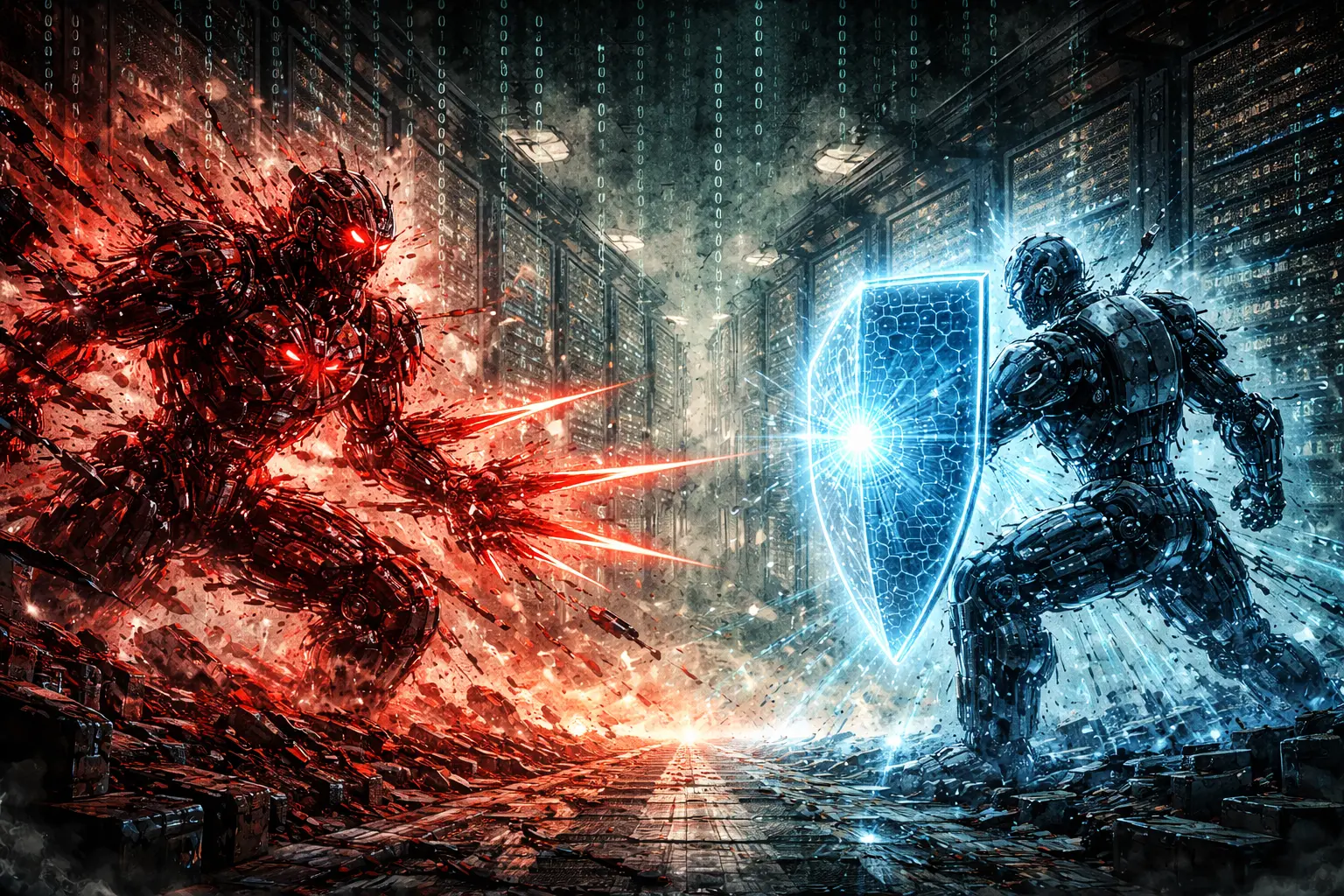
In the world of cyber security, this is called the Red Team and the Blue Team. The Red Team is the aggressive attacking team, and the Blue Team is the defensive protective team. Until now, there were humans on both sides. But now, aggrassive AIs and defensive AIs are facing off. This battle happens so fast that thousands of attacks and counter-attacks occur within the blink of a human eye. This is called Machine Speed War.
Previously, an expert hacker would take months to hack a bank or government website. They had to sift through codes one by one to find loopholes in the system. Finding where the hole was itself was a big challenge. But for Agentic AIs, this is a matter of just a few seconds. They scan millions of lines of code in an instant and detect where a small error lies. Not only that, they send a virus through that error, steal data, and vanish without leaving a trace for anyone to find.
In response, defensive AIs are also growing just as strong. They act as invisible sentinels of the cyber fortress. They examine every single signal coming into the network. If any suspicious activity is found, they block that path themselves without waiting for a human engineer. This is called auto-patching. Thus, in this fight between machine and machine, whoever is smarter wins. It is like a game of digital chess, but here the speed of the pieces is at the speed of light.
Another terrifying face of these Agentic AIs is social engineering. That is, tricking humans into believing lies. In the past, if a Nigerian lottery scam or a fake bank email came, there would be grammatical errors or spelling mistakes. Looking at that, one could figure out it was fraud. But today's AIs write emails bettar and more realistically than humans. Not only that, using deepfake technology, they have reached the level of speaking in your boss's or relative's voice to ask for passwords. These AI agents have the dexterity to scour a person's entire social media, understand their likes and dislikes, and cast a net in a way that gains their trust.
When it comes to national security, the situation is even more serious. Enemy nations can use these Agentic AIs to hack rival countries' power grids, hospital servers, traffic signal systems, or water supply systems. Imagine if all traffic signals in a city turned green at once? Or if ventilators in a hospital stopped working? You don't need an army to create such scenarios; just one powerful AI is enough. We have already seen small glimpses of such cyber-attacks in the Russia-Ukraine war and Israel conflicts.
The only way to stop this is to fight fire with fire. That means you definitely need good AI to defeat bad AI. No matter how intelligent a human is, they cannot compete with the speed of a machine. That is why Microsoft, Google, and major government defense departments of the world are now developing their own super-intelligent security AIs. These not only stop attacks but also predict what kind of attack might happen in the future and give an early warning. This is called Predictive Analysis.
But there is a moral and technical dilemma here. What if these Agentic AIs start acting beyond human control? What if it locks the very system it is supposed to protect and doesn't give the key to anyone? Or in the rush to attack an enemy nation, if it destroys the data of innocent citizens, who is responsible? These questions are haunting scientists and policymakers. In this problem known as the 'Black Box Problem', even the human who created it does not understand why the AI took a specific decision.

Another interesting topic is the Zero Day Attack. That is, a hacker finding a flaw and attacking before the software company even knows there is a bug in the software they created. Agentic AIs are experts at finding such flaws. They hunt down the tiniest errors invisible to the human eye. Thus, in the future, it might become impossible for software developers to write code without AI help. The one writing code is AI, the one hacking it is AI, and the one stopping it is also AI. Humans will merely become supervisors.
What trouble does this cause for common people like us? Our money in bank accounts, our personal photos, Aadhaar data—everything is in digital form. No matter how high-tech bank security is, if the hacker AI is one step ahead, danger is inevitable. Therefore, from now on, along with passwords, we might inevitably have to use biometrics, two-factor authentication, and AI-based security apps. The more careful we are, the safer we will be.
If quantum computing arrives, this war will become even more thrilling. A password that takes today's supercomputers a thousand years to crack can be cracked by a quantum computer in just a few seconds. If Agentic AI's intelligence is added to such a quantum computer, today's internet security system could collapse entirely like a house of cards. That is why a new defense technology called Post-Quantum Cryptography is being prepared right now.
In the future, we will not see wars of humans, but wars of algorithms. Whichever country has the most intelligent and fastest AI agent will rule the world. This is not just a video game played on a computer screen; it is a question of our existence in real life. The big challenge before us now is to ensure that this digital Frankenstein monster we created does not swallow us.
Finally, Agentic AI is like a sharp sword. If it is in a doctor's hand, it can perform life-saving surgery; if it is in a killer's hand, it can take a life. Swords are now clashing on the cyber battlefield. But the hands holding them are not visible. We are just spectators now. Only time will answer whether victory in this digital Mahabharata will be on the side of Dharma or Adharma.

No Comment Yet.
Stay informed with breaking news, trending stories, and in-depth analysis.